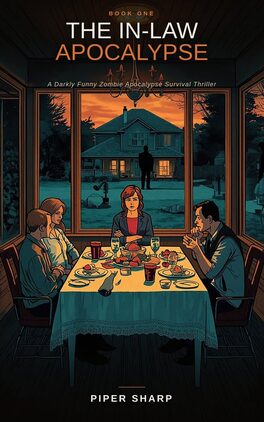
Here is a thing nobody tells you about the end of the world: it starts exactly like every other terrible Sunday dinner at your in-laws’ house, and for the first eleven minutes, you cannot tell the difference.
I want that on the record, because later, much later, while I was filtering pond water through a bottle sock and Doug was reciting drowning statistics at me, I would have given a great deal to have had some warning of any kind, a siren or a comet or anything with more dignity than what actually happened, which was that my mother-in-law refilled the bread basket, my father-in-law explained why the bread basket was a fire hazard, and somewhere behind me my brother-in-law said, “Say hi to the stream, Grandma’s meatloaf,” to a phone that forty people were watching, right before a man named Gary Pelletier ate his own wife on the front lawn.
In fairness to Gary, we didn’t know his name yet, and we only found it out later, off his mailbox, by which point it had stopped being relevant to anyone but the mailbox.
Let me back up and explain how a person ends up filtering pond water through a sock in the first place, because Sunday dinner at Carol and Doug’s happened every week at six p.m., not six-oh-five, a fact Carol had communicated to me approximately four hundred times since Sam and I got married, always in the tone of someone sharing a delightful family tradition and never in the tone of someone issuing a threat, even though it was, factually, both.
The dining room table was set with the good placemats, and there was a laminated seating chart taped to the inside of the pantry door that nobody was supposed to know about, which of course everybody knew about, because Carol had laminated it at the actual FedEx Office, where the woman behind the counter happened to be Doug’s second cousin, and gossip is not a lost art in this family.
“Riley, you’re between Sam and Tyler again,” Carol said, not looking up from the gravy. “I’ve moved the candles so you’re not breathing the smoke.”
“Thank you, Carol.”
“It’s not for you, it’s for the tablecloth.”
That was Carol, who loved you the way she loved a well-organized junk drawer, completely, and also as a system that could stand to be optimized.
Doug was already at the head of the table, going through his phone with the specific frown he reserved for actuarial tables and, apparently, the bread basket, which Carol had just set down directly under the ceiling fan.
“That’s a hazard,” he said.
“It’s bread, Douglas.”
“Ceiling fan’s on medium. Crumbs aerosolize at that speed. I read a paper.” He turned to me for backup, the way he always did, because I was the only other person at the table who would occasionally pretend his facts were interesting instead of just true. “Did you know more people die from choking on bread products than from actual home invasions?”
“I did not know that, Doug.”
“Nobody does. That’s the problem with home security. Everyone’s worried about the wrong statistics.” He said this with the weary patience of a man who had spent thirty-one years pricing risk for an insurance company and had never once, not for a single day, stopped doing it for free.
Behind me, Tyler had his phone propped against the salt and pepper shakers, angled at his own plate. “What’s up, degenerates, it’s meatloaf night at the ’rents, we’re live, say hi.” He waved two fingers at the camera without looking at it. Tyler had been a moderately successful gamer for six years, the kind of successful where strangers in three countries knew his laugh but his own mother still asked if he had “found anything yet,” and he had not, as far as I could tell, ever once considered that the follower count under his username, forty thousand, then twelve thousand, then, as of last month, three hundred and forty, might mean something was wrong with the follower count and not with the meatloaf content.
“Forty followers watching me eat is not the flex you think it is,” I said.
“Three hundred and forty, and it’s not about the number, Riley, it’s about building a community,” Tyler started, except he never got to finish it, because Sam, my husband, put a dinner roll directly into Tyler’s open mouth without breaking eye contact with me, which is one of maybe four reasons I married him.
This was the whole cast on most Sundays: Carol running her household like a wedding she had never stopped planning, Doug narrating catastrophe as a form of affection, Tyler performing a life for an audience that had quietly wandered off, and Sam, the only certifiably normal person in the building, aggressively and almost suspiciously normal, as if normalcy were a skill he had trained for. And then there was me, the daughter-in-law, five years in, still not entirely sure whether I had married into a family or a very small and very specific cult, but committed to it either way.
We were eleven minutes into dinner, a fact I checked later because the timeline turned out to matter to Doug in a way that made everyone deeply uncomfortable, when the neighbor’s dog started screaming.
It was not barking, and I want to be precise about that, because at the time none of us were, which cost us maybe ninety seconds we didn’t have. Dogs bark, and this was screaming, high and continuous, the sound stretching out longer than a dog’s lungs should have allowed, coming from the Pelletiers’ yard two doors down, visible through Carol’s big dining room window if you turned your head, which Doug did, mid-sentence, and he never finished that sentence.
“Douglas?”
He didn’t answer her, only went very still, the way he got right before he told you something you didn’t want to hear, except this time there were no numbers in it, just his hand coming up slowly to point toward the window, and all four of us turned to look.
Gary Pelletier was on his lawn, and his wife, Marion, was under him. I am not going to describe what he was doing in any detail, because I still do not love thinking about it and because it is not actually the important part, which is that Marion Pelletier had been, by all accounts, a perfectly nice retired librarian who ran the neighborhood book club and made a lemon bar that Carol had tried and failed to replicate for six years, and she was making a sound no perfectly nice retired librarian should have been capable of making, and Gary was not stopping, and nobody at that table moved for four full seconds, because the human brain, it turns out, needs a moment to agree that what it is looking at is real.
Tyler’s was the first voice to break the silence, saying, “Is that… okay, that’s messed up, somebody call…” before he actually reached for his phone and remembered it was already recording, at which point three hundred and forty people got to watch, in real time, the exact moment my brother-in-law’s audience became a witness list.
“Get away from the window,” Sam said, and here’s the thing about my husband: aggressively normal people are usually the calmest ones in a room, because they’ve spent their whole lives being the control group. He said it quietly and he was already moving, already had a hand on my chair, and I stood up so fast I knocked Carol’s good placemat onto the floor and nobody said a word about the placemat, which is how I knew, on some pre-verbal animal level, that the world had actually changed.
Carol, to her enormous credit, did not scream, but went straight to the front door and threw the deadbolt and the chain, then stood there with her hand flat against the wood as if she could feel through it whether anything was on the other side, and said, in the same voice she used to announce that dinner was at six, not six-oh-five, “Doug. Blinds. All of them. Now.”
Doug moved, which was the other thing about Doug: thirty years of pricing out worst-case scenarios for a living meant that when the worst case actually arrived, some part of him had been rehearsing for it since 1994, and he crossed that living room like a man who had been waiting his whole life to finally be right about something. He pulled the blinds down and yanked the curtains shut, reciting under his breath the whole time, not really to anyone, just processing out loud the way he did, “Contagion vector, contagion vector, has to be contagion, that’s not psychiatric, nothing psychiatric does that to a jaw,” and normally I would have told him to stop narrating and just move, but normally Doug was wrong, or at least unverifiable, and right now Doug had clearly already solved a problem the rest of us hadn’t caught up to yet.
“What do you mean contagion?” Tyler’s voice had gone up an entire octave, and he still had the phone in his hand, which had not stopped recording. I would like to say that I judged him for that later, and I did, briefly, right up until the point several weeks on when that same habit ended up saving all our lives, though that part comes later and is not really this chapter’s problem.
“I mean,” Doug said, snapping the last blind down, “that whatever that man has, Marion has it too now, and I would put real money, real money, Carol, you know I don’t say that lightly, on it not staying in that yard.”
Outside, the screaming had changed register and multiplied, and there were at least two voices now, maybe three, and under it, a sound I would spend the next several months learning to recognize instantly and never once get used to: a low, wet, group moan, dozens of throats doing roughly the same thing at roughly the same volume, coming from somewhere down the block and getting less “somewhere” and more “here” by the second.
My phone buzzed, then Sam’s, then, half a second later, everyone’s at once, that specific chorus of simultaneous notification that means either a scam text has hit the whole zip code or something has gone extremely and officially wrong. It was an Emergency Alert, the kind that usually means flash flood or Amber Alert, the all-caps government voice you never actually expect to mean anything:
CIVIL EMERGENCY. SEEK SHELTER IMMEDIATELY. AVOID CONTACT WITH INFECTED INDIVIDUALS. DO NOT USE MAJOR ROADWAYS. FURTHER INSTRUCTIONS TO FOLLOW.
There were no further instructions, not that night and not really ever, which tells you almost everything you need to know about how prepared anyone actually was for this.
“Okay,” Carol said into the silence after the alert tone died, in the exact tone she used for reorganizing a wedding seating chart around a last-minute plus-one, “we are not staying in a house with this many windows.” She looked at Doug. “The basement first, five minutes, then we grab what’s in the pantry and the go bags.”
“You have go bags,” I said.
“I have go bags,” Carol said, like I’d asked whether she owned a vacuum. “I’ve had go bags since 2019. Nobody wanted to talk about it at the time.”
Nobody had wanted to talk about it at the time, and I filed that away along with a great many other things I owed Carol Cooper an apology for, assuming any of us lived long enough for me to actually deliver it.
Sam had gone still at the window, one finger hooked in the blind, looking out through a half-inch gap he had absolutely no business looking through, and when I asked him what he saw his voice came out flatter than I’d ever heard it.
“Riley. Front door.”
I heard it before I understood what I was hearing: a slow, deliberate weight coming up the porch steps outside, the boards groaning under something that did not know or care that groaning boards mean a person is about to be heard. Then a hand, I have to assume it was a hand, since it hit the door like one and simply did not stop like one, slammed flat against the wood, once, twice, three times, and Marion Pelletier’s voice, or what used to be Marion Pelletier’s voice, came through the door in a register that made every hair on my arms stand straight up, asking, with terrible and patient clarity, to be let in for book club.
Carol did not move her hand off that deadbolt, not one inch.
“Nobody,” she said, “is opening that door.”
And that was exactly the moment the handle started to turn beneath her palm.